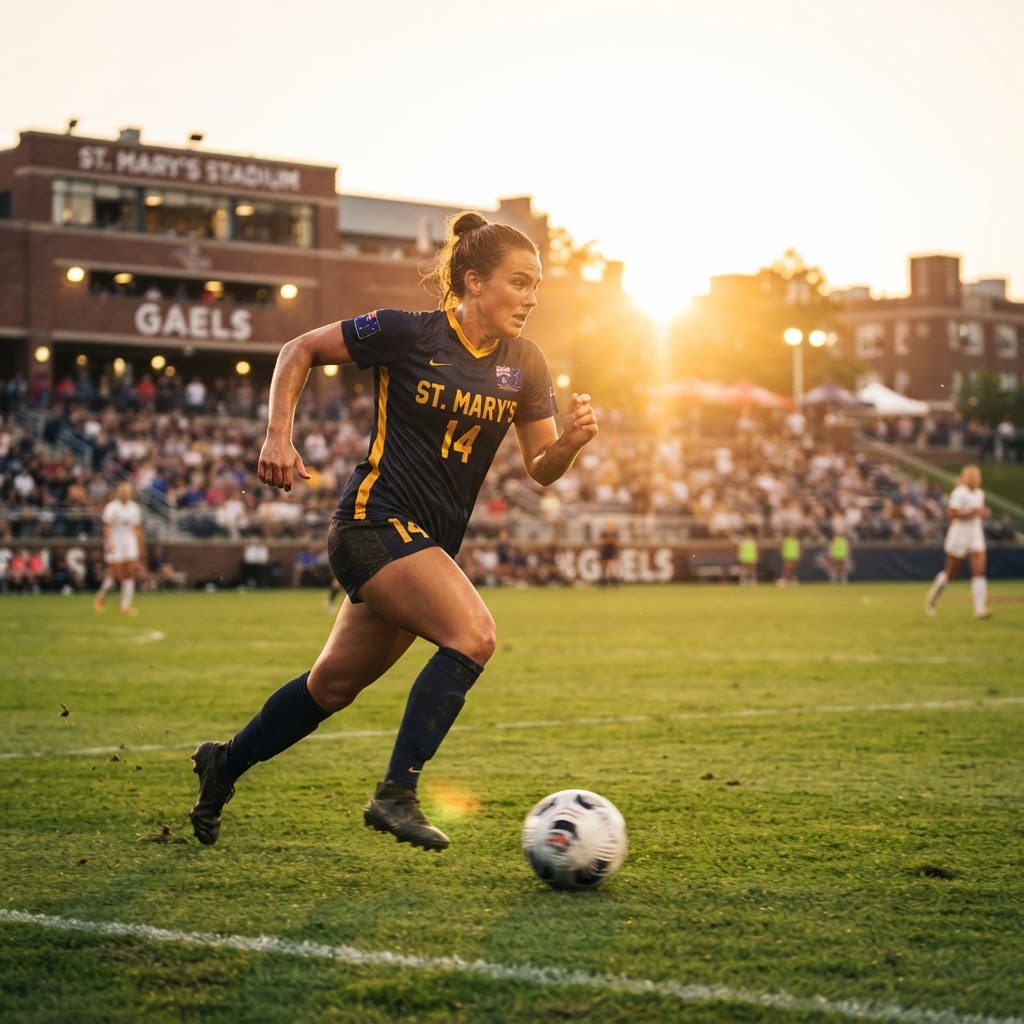
The first question I get from almost every Australian family is: "Can my son/daughter play D1?"
The second question — if they've done any research at all — is: "How do we get a D1 scholarship?"
D2 doesn't come up. Not because they've thought about it and ruled it out. But because they don't actually understand what it is.
After 16 years placing Australian athletes into the US college system, I can tell you: this is one of the most expensive misunderstandings in the pathway. Families who chase D1 and miss, end up scrambling in Year 12. Families who understand D2 from the start end up in the right program, with real scholarship money, at schools that are actively recruiting them.
Here's what D2 actually looks like — and why it's consistently the best pathway for a large proportion of serious Australian athletes.
What D2 Actually Offers
NCAA Division 2 programs offer up to 9 scholarship equivalents for men's soccer and 9.9 for women's. That money gets split across a roster of 22–28 players — which means partial scholarships are the norm, not full rides.
But "partial scholarship" is doing a lot of work in that sentence.
When an Australian family hears "partial scholarship," they picture a small discount. What D2 coaches actually offer looks more like this:
- 40–60% of tuition covered by athletic scholarship
- Merit aid on top (D2 schools can stack academic and athletic awards)
- Out-of-pocket costs that are genuinely comparable to — or lower than — what a D1 partial scholarship family pays after full costs are accounted for
Saskia Vos, one of our athletes from Westfields Sports High, landed at the University of Rio Grande (NAIA — same scholarship structure) with an $84,000 scholarship. Vincent Giannini at Bowling Green State (D1 — MAC) earned a full athletic scholarship plus Academic All-MAC recognition. Lachlan Maher (D2 — Newberry College) is playing competitive soccer while completing his degree.
These outcomes are not accidents. They're what happens when an athlete is matched to the right level — not just the highest-sounding one.
The D1 vs D2 Misunderstanding
Here's the thing most families don't know: D2 schools are in direct competition with D1 schools for the same pool of international athletes.
Why? Because D1 coaches — especially at mid-major programs — are operating under scholarship restrictions. Before the House Settlement, D1 men's soccer had 9.9 scholarship equivalents for an entire roster. They were rationing. That's changed in 2025, but the competitive dynamic for international athletes specifically is still very real.
D2 coaches can often move faster, offer more per player (relative to roster size), and build genuine long-term relationships with agents and services like ours. I've had D2 coaches offer a player more guaranteed money than a D1 coach who was asking the family to "wait and see."
Speed of offer and certainty of funding are two things most Australian families never factor in. They fixate on the division number.
The Athletes Who Thrive at D2
Not every athlete is a D1 prospect. That's not an insult — it's a recruiting reality.
D2 is the right pathway when:
- The athlete has strong technical ability but hasn't played at the highest domestic level (NPL D1, A-League academy)
- The athlete prioritises a quality education alongside competitive soccer
- The family wants certainty of scholarship money over the prestige of a D1 badge
- The athlete's graduation year means they're competing in a crowded recruiting cycle
Some of the strongest outcomes I've seen across 16 years of placements have been at D2 schools. Connor Wilkinson and Michael Blancato at Mercyhurst (D2 — PA). Marcus Plataniotis at Hawaii Hilo (D2 — HI). Ali Cook at Concord University (D2 — WV). Matilda Boyle transferred from D1 Long Island University to Wingate (D2 — NC). Georgia Fogarty at St. Edward's University (D2 — TX).
These athletes graduated. Some competed at the highest level in their conference. Some went on to professional opportunities. None of them "settled" for D2 — they chose it because it was the right fit.
What Families Get Wrong About D2 and D1
Myth 1: D2 coaches aren't as good.
False. Some of the most sophisticated soccer coaching in the US happens at the D2 level. Coaches at D2 programs often have the same credentials and experience as their D1 counterparts — with smaller rosters and more individual attention per player.
Myth 2: D2 won't help my child go pro.
The path to professional soccer in the US runs through USL, MLS Next Pro, and MLS — not through D1 specifically. Angus Till, one of our athletes from Barker College Sydney, went to Ferrum College (D2) and has gone on to play USL League Two every season — the elite semi-professional level in the US system. The division didn't determine the ceiling. The athlete did.
Myth 3: D2 scholarships are smaller.
Per-athlete, D2 scholarships are often competitive with D1. The difference is D2 coaches have fewer equivalents to spread — which means when they commit to a player, it's a genuine commitment. A D1 coach hedging with 5% of a scholarship is not more valuable than a D2 coach offering 40%.
Myth 4: D2 is easier to get into.
Academically, some D2 schools are highly rigorous. Athletically, the competition at D2 is genuine. Australians who assume D2 is "the backup option" and haven't trained at the right level will not get recruited at D2 either.
How to Know If D2 Is Right for Your Athlete
The honest answer: you need someone who has seen enough placements at every level to read the gap between where an athlete is and what a given program needs.
What I look for when assessing D2 fit:
- Domestic level — NPL State League vs D1 vs Academy matters. US coaches watch footage with specific reference points. I translate what Australian competition levels actually mean in US recruiting terms.
- Position scarcity — A goalkeeper from a strong program will get different offers than a midfielder from the same program. Supply and demand is real at every level.
- Academic profile — Some D2 schools have merit aid that makes the total package more attractive than a stripped D1 offer. A strong academic athlete should always be looking at both.
- Timeline — A Year 10 athlete has time to build a profile and attract genuine D1 interest. A Year 12 athlete entering the cycle late has less leverage to wait for D1.
The Bottom Line
D2 is not a consolation prize. It's a recruiting category that produces professional athletes, Academic All-Americans, conference champions, and university graduates who used their sport to access an education they couldn't have got any other way.
The families who understand this from the start build better recruiting strategies, have more genuine options, and end up at programs where their son or daughter will actually thrive.
The families who chase D1 because it sounds better — and wait too long, reject too many offers, and end up with nothing confirmed in Year 12 — are the ones I hear from in a panic.
If you're not sure which division realistically fits your athlete right now, that's exactly what our Pathway Session is designed to answer. Sixty minutes, real assessment, no sales pitch — just clarity on where your son or daughter sits and what the pathway actually looks like.
The session fee is credited back in full if you move forward. But the real value is knowing.
Book a Pathway Session
A focused 60-minute strategy session with John Stevanja — covering your athlete's division fit, scholarship stacking potential, and realistic pathway options across D1, D2, NAIA, and NJCAA.
$165 AUD · Fully credited back if you join our programme
Book Pathway SessionJohn Stevanja is the founder of Upper 90 College, with 16 years placing Australian athletes into the US college soccer system across all divisions. Upper 90 College has produced 6 national champions and placed athletes into 700+ programs across D1, D2, D3, NAIA, and NJCAA.