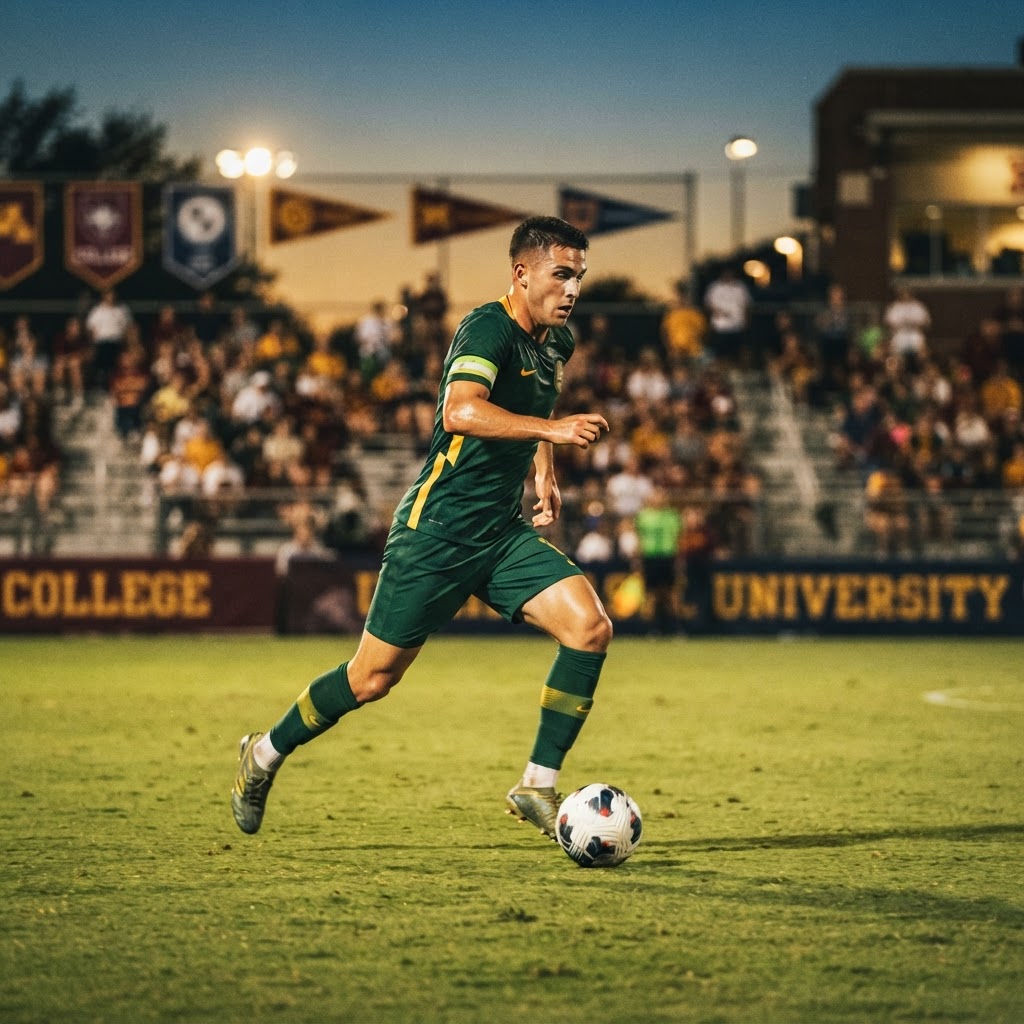
On June 13, 2026, lounge rooms across Australia lit up in the early hours as the Socceroos made history. The green and gold secured a historic 2-0 victory over Turkey on football's biggest stage, with goals from Aiden O'Neill and Nestory Irankunda. For Australian parents watching, it was a moment of pure inspiration. But elite football is relentless. Just six days later, on June 19, the USA defeated Australia 2-0 — demonstrating the high level of modern, physical, and disciplined play in the American system.
As the World Cup wraps up — Spain crowned champions today — parents of talented 15-to-18-year-old soccer players are asking: How does my kid actually get there? What is the real, modern Australian soccer World Cup pathway?
For years, Australian families believed that if their child didn't sign an A-League academy contract by age 15, the dream was over. This World Cup has completely shattered that myth. The proof lies in Major League Soccer.
What the Three MLS-Based Socceroos Prove
Three players in the Socceroos' World Cup squad play their club football in Major League Soccer:
- Aiden O'Neill (Brisbane, QLD): Brisbane → Celtic → Colorado Rapids → NYCFC (MLS) → Socceroos. His goal against Turkey. Proof the American system is a legitimate elite environment.
- Kai Trewin (Batemans Bay, NSW): 25 years old. NYCFC. World Cup 2026. From a regional NSW town to the world stage — not via Europe, not via an A-League academy.
- Lucas Herrington (Brisbane, QLD): 18 years old. Colorado Rapids. The youngest player in the Socceroos squad. He's the same age as some of the kids I'm working with right now.
These three players didn't follow the same path. But they ended up wearing green and gold at a World Cup. MLS was the bridge.
The Connection: US College → MLS → Socceroos
Here's what most Australian families miss: the US college soccer system is the primary pipeline into Major League Soccer.
In the US, university sports are a highly funded developmental tier. MLS clubs scout college programs relentlessly, using the annual SuperDraft to select the best players and place them directly into professional environments. By entering the US college system, an Australian player gains access to state-of-the-art facilities, professional coaching, elite conditioning, and massive scout exposure — all while earning a world-class degree. Players develop between 18 and 22 instead of being discarded by a local system that has no place for them.
Some families point to Nestory Irankunda as the standard. Born in Tanzania, raised in Adelaide — Adelaide United → Bayern Munich → Watford FC (EFL Championship). He scored against Turkey. He's phenomenal. He's also a 0.1% outlier who has never played in MLS and never went to US college. Chasing that path for most players leads to burnout and an empty CV at 19.
For the other 99.9%, the US college-to-MLS pipeline is the most realistic, funded, and structurally sound route available.
Dom Dwyer: Proof the Launchpad Can Start Anywhere
If your child isn't recruited by a major D1 program straight away, the door isn't closed.
Dom Dwyer was released by Norwich City at 17. He went to Tyler Junior College in Texas — NJCAA, not NCAA. Scored 52 goals in 42 games. Won two national titles. Named JUCO Player of the Year. Transferred to USF D1. Drafted 16th overall in the MLS SuperDraft. Over 115 professional goals across Sporting KC, Orlando City, Atlanta United, and Toronto FC.
The JUCO pathway most families skip straight past is a legitimate launchpad. No SAT. No ACT. No HS prerequisite subjects — just a diploma and a 2.0 GPA. In America, it doesn't matter where you start. It only matters how you perform.
What This Means for Your Kid Right Now
The World Cup ends. Your child's window doesn't wait for the news cycle.
US coaches recruit 12 to 24 months in advance. The US Class Year is always your child's Australian graduation year + 1:
- Year 12 (graduating late 2026): Targeting US Class of 2027
- Year 11 (graduating 2027): Targeting US Class of 2028
- Year 10 (graduating 2028): Targeting US Class of 2029
Year 10 and 11 is your peak window. Families who move now have real options. Those who wait until Year 12 compete for what's left.
16 years. 700+ programs. 6 national champions. I speak plainly — parent to parent.
Book a Pathway Session — 60 minutes, your athlete's specific situation, real answers.